01
Model the company
Map how value is created: functions, governance, workflows, dependencies and the evidence behind them.
The Straxia platform
AI helps prepare business-wide context and options for leadership review. Your team challenges the evidence, decides what to do and owns the commitments. Then you return to observed outcomes—not another isolated dashboard or unowned recommendation. Start with the information your teams already use; availability and implementation scope are confirmed during discovery.
Read the guide to AI management systems for leadership teamsA concrete management moment
A prepared view brings the margin signal, source context and possible responses into the meeting. Leaders challenge the interpretation and choose the next step—an illustrative scenario, not a reported business result or live AI output.
Different explanations. An unclear decision. No agreed next step.
Challenge assumptions. Clarify the choice. Support the follow-through.
A clearer decision. A named owner. A defined next review. The outcome remains to be verified.
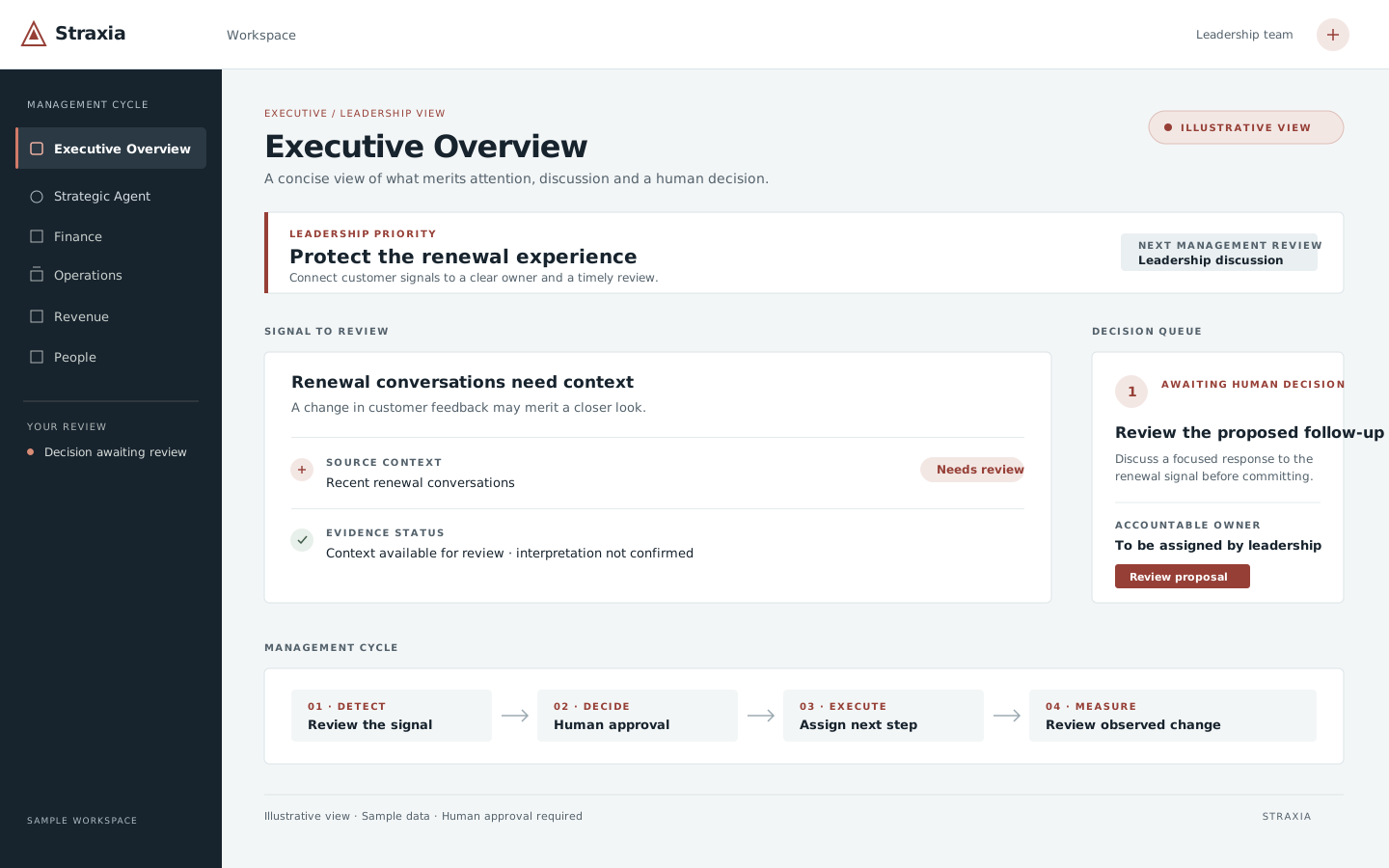 Illustrative product concept · Sample data · No live business actions.
A structured view of the business
These are concept directions, not six replacement modules. The Straxia system is organized across Executive, Strategy, Finance, Operations, Revenue and People. What is available, configured or appropriate is confirmed during discovery.
Map how value is created: functions, governance, workflows, dependencies and the evidence behind them.
Bring financial statements, operating assumptions, costs and cash drivers into a reviewable model.
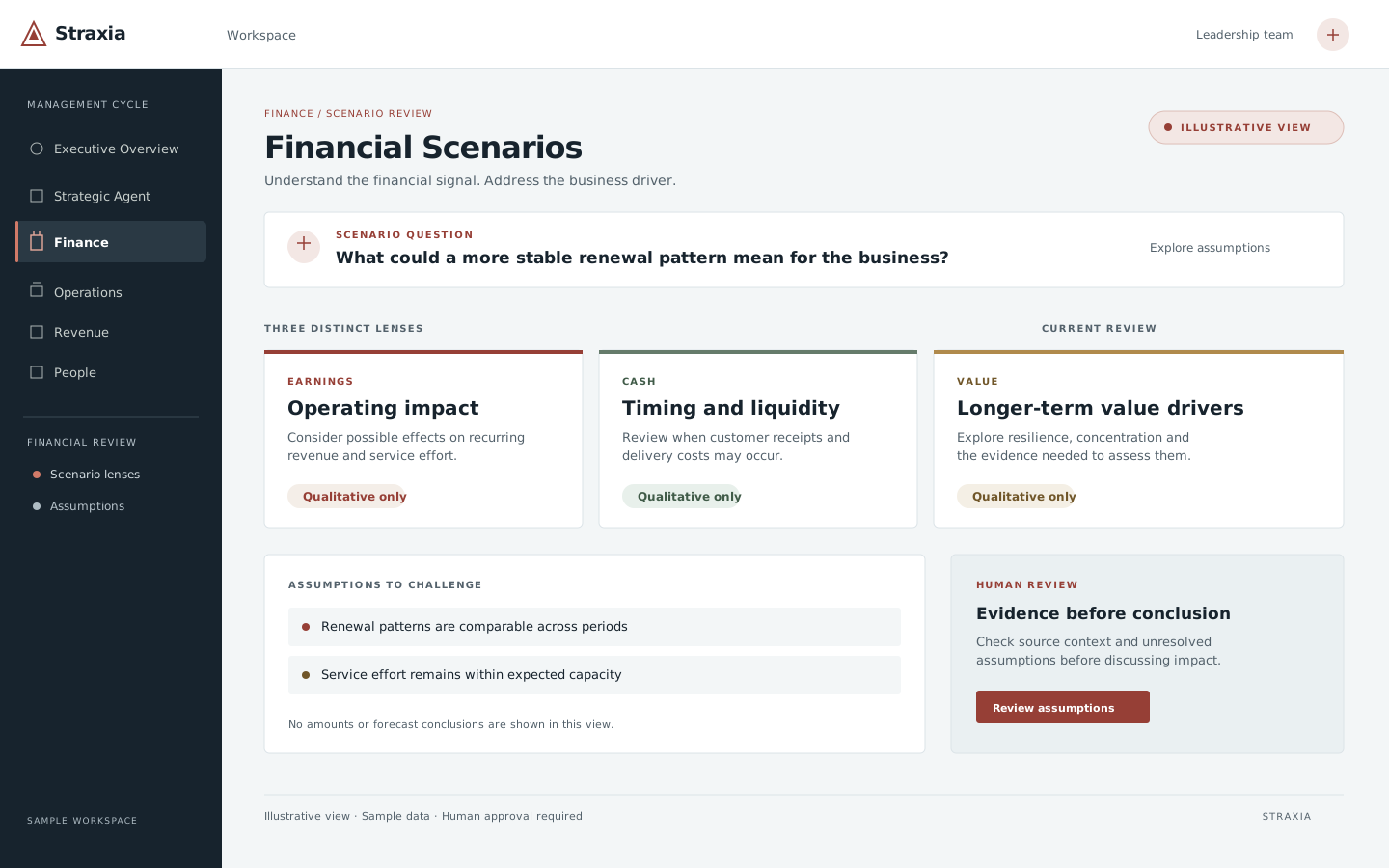 Illustrative product concept · Sample data · No live business actions.
Connect priorities, measures, initiatives and the next review in a rhythm shaped for the team.
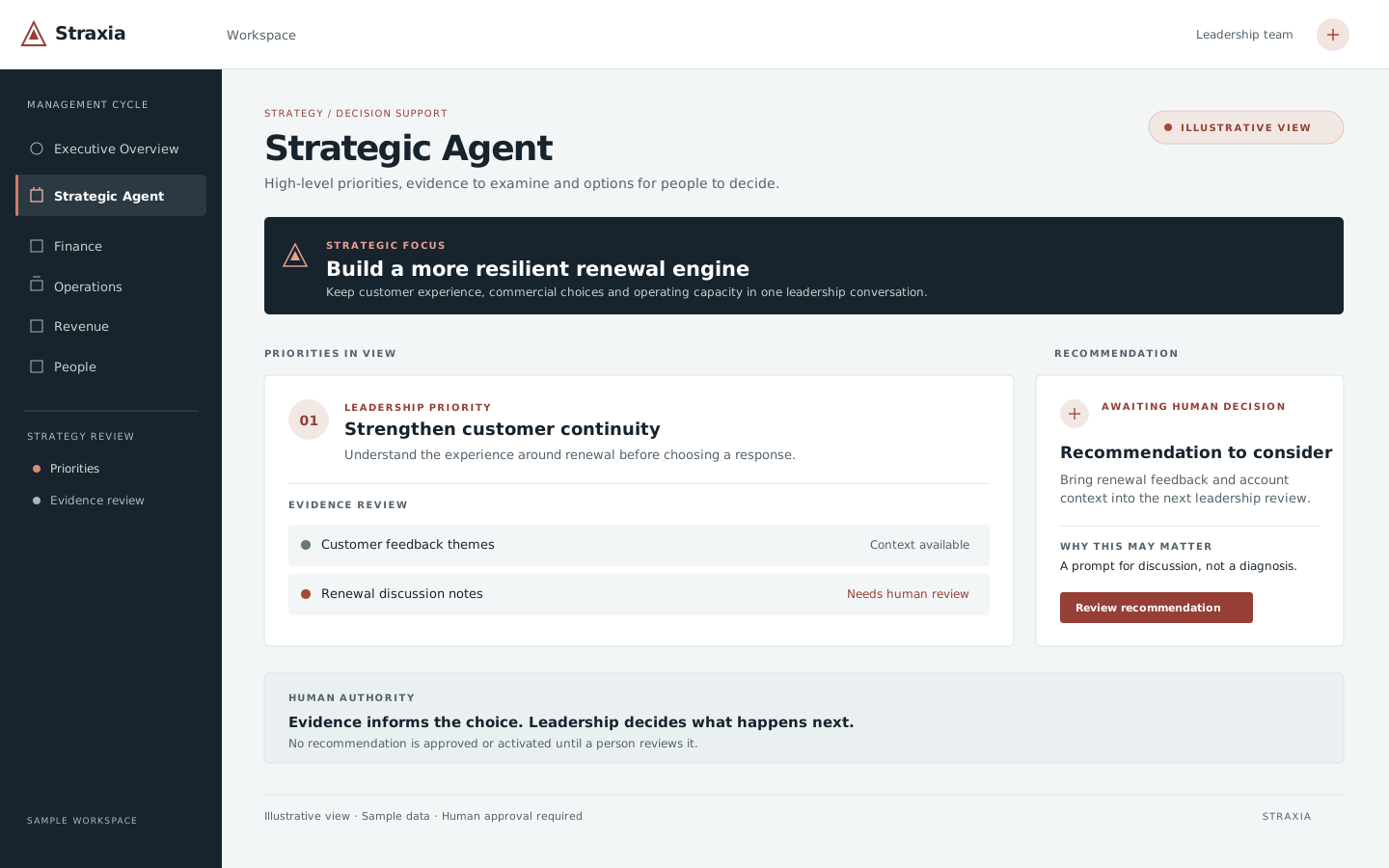 Illustrative product concept · Sample data · No live business actions.
Explore how specialist analysis could support finance, strategy, operations and people—with human review.
Make execution friction, capacity constraints, dependencies and potential options easier to examine.
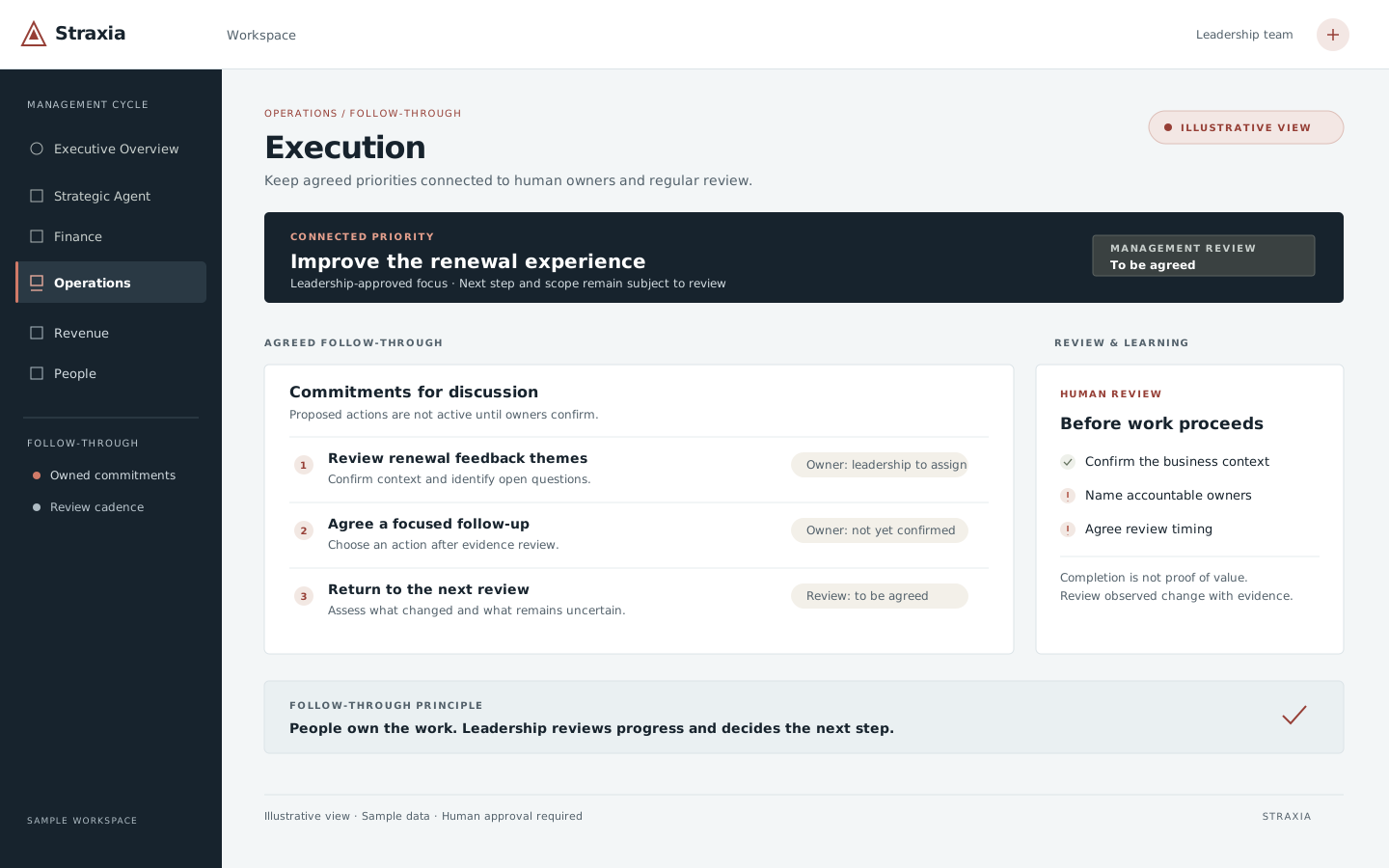 Illustrative product concept · Sample data · No live business actions.
Review outcomes and proposed improvements; people validate evidence and approve any change.
Artwork is illustrative reference material. Sample values are not verified results or live product screenshots; capability availability, integrations, automation and delivery scope require discovery.
From context to review
The platform concept makes the journey from a business question to a reviewed outcome easier to follow. Evidence quality matters: missing or stale evidence blocks a supported conclusion and approval.
A signal is not a diagnosis. A proposal is not an approval. Completion is not proof of value.
01
Frame the operating question against plans, constraints, priorities, and the systems a team already uses.
Business context
Illustrative interface view
02
Examine where evidence came from, which period it covers, and whether it is fresh enough to use.
Evidence
Illustrative interface view
03
Make the links between operational conditions, financial considerations, and revenue priorities visible.
Relationships
Illustrative interface view
04
Turn a supported interpretation into a proposed action, with its rationale and open questions in view.
Decisions
Illustrative interface view
05
Make the accountable owner, human approval, and agreed follow-up clear before work proceeds.
Commitments
Illustrative interface view
06
Return to the expected and observed results, attribution, costs, and what still needs to be measured.
Outcome review
Illustrative interface view
Roles and trust
Agree the responsibilities and validate the controls before introducing a workflow.
Direction, context, approvals and accountability.
Company context, evidence, model outputs and execution visibility.
Specialist judgement, configuration and implementation support within an agreed mandate.
Value Ledger
The Value Ledger is a place to trace the baseline, source, period, owner, action, expected and observed value, attribution, costs, and review. An observed result can remain awaiting review; verification is performed internally by people, never assumed or automatically verified.
Expected — an estimate or intent, not an achieved result.
Observed — recorded and awaiting review until examined.
Verified internally — explicitly reviewed by the responsible people.
Value Ledger
Illustrative interface view
Proposed architecture · not an activated workflow
Connect value creation, support and governance around a shared company model. Explore dependencies, examine the economics and challenge the guidance—with human review before action.
Bring business data, field signals and user questions into review.
Examine maturity gaps, dependencies and specialist perspectives.
Compare scenarios and make financial assumptions explicit.
Question, correct, approve or defer. People retain decision authority.
Check capacity and resources before people advance initiatives and OKRs.
Approved only
Review observations and financial effects before proposing a model change.
Evidence, financial rules, processes and capabilities should remain reviewable. Traceability and storage controls must be validated within the implementation scope.
Learning proposals require evidence, human approval, testing and a reversal plan before a new model version is introduced.
Design principle: agents propose. People approve. Calculations remain traceable.
This diagram adapts the supplied conceptual architecture. It does not establish deployed agent execution, encrypted storage or automatic learning. The site's tour is a simulation: no company systems are connected and no business actions are taken.
Explore the illustrative tourThe product views shown on this site illustrate the intended Straxia experience. Available modules, integrations, automation, and delivery scope are confirmed during discovery.
Walk through a qualitative delivery-delay and freight-cost scenario. Examine evidence and decisions in a simulated, non-operational tour.
Start the interactive tour